Key Takeaways
- Myopia and hyperopia are both refractive errors, and both are common.
- With myopia, distance vision looks blurry while near vision typically stays clearer.
- With hyperopia, near vision looks blurry while distance vision typically stays clearer.
- Squinting, tired eyes, and headaches can show up with either one.
- Specialized glasses, contact lenses, and myopia control options for kids can help slow progression.
- An eye exam confirms which refractive error you have.
Your child keeps scooting closer to the television to see their cartoon. Your spouse squints at the menu, struggling to read what today’s specials are in the dim lighting. Someone in the car says the word “nearsighted,” someone else says “farsighted,” and nobody’s quite sure which one means what. Those two words come up often at Eye Care for East Texas.
The difference comes down to where your vision blurs. Myopia, or nearsightedness, makes distant things look fuzzy while closer things typically stay clearer. Hyperopia, or farsightedness, does the opposite, with near objects looking blurry while distance vision typically stays clearer.
What Myopia Looks Like Day to Day
Myopia often shows up in childhood and can keep progressing through the teen years. If you needed glasses as a kid, there’s a good chance your child might too, since family history plays a role.
Day to day, it can look like a kid moving closer to the TV or a teen who can’t read the whiteboard from the back row.
Signs to Watch For
- Bringing reading materials closer to the face
- Squinting at things far away, along with eye strain
- Headaches after driving, watching a game, or other distance tasks
Myopia Control for Kids
When a child’s prescription keeps climbing, myopia control can help slow that progression. Options include special glasses, contact lenses, or prescription drops, and an eye doctor in Longview can walk you through which fits your child’s routine.
Small habit changes support the plan too. Balancing screen time with outdoor time gives young eyes a break from close-up focus.
What Hyperopia Looks Like Day to Day
Hyperopia is less common than myopia. Mild cases may not affect your vision much at all, which is why some people go years without realizing they have it.
When it does show up, you notice it during close work. Think of the fine print on a prescription bottle or a long evening of paperwork that leaves your eyes aching.
Many children are farsighted at birth and improve as their eyes grow.
Signs to Watch For
- Blurry vision while reading
- Tired eyes after close work like sewing, crafts, or paperwork
- Headaches and trouble focusing on things up close

How the Two Compare Side by Side
While both conditions share common symptoms like squinting, tired eyes, and headaches, their underlying optics are opposites. A myopic eye is longer from front to back, causing light to focus in front of the retina. A hyperopic eye is shorter, meaning light focuses past it. Because these signs overlap so heavily, guessing the difference at home rarely works.
Where Astigmatism and Presbyopia Fit In
While myopia and hyperopia handle how the eye focuses light overall, other common refractive errors frequently join the picture.
Astigmatism is a separate structural variation where the cornea or the lens inside the eye curves more steeply in one direction than another, resembling an oblong football rather than a round sphere. This uneven curvature bends light at different angles, creating distorted or blurred vision at any distance. You can easily have astigmatism alongside either myopia or hyperopia.
Presbyopia takes a different path entirely. Instead of being tied to the length of the eye, it is a natural, age-related change that typically becomes noticeable in your early to mid-40s. The crystalline lens inside your eye gradually loses its youthful flexibility, making it harder to focus quickly on close-up tasks like reading a text message or a restaurant menu, even if your distance vision remains clear.
Correction Options
Glasses and contact lenses can correct both myopia and hyperopia. Once a prescription stays stable, laser vision correction becomes another option worth discussing.
Reasons to Book an Exam
If you are wondering whether it is time to check your vision, certain everyday signs often point toward a shifting prescription. You should consider booking an exam if you notice:
- Persistent blurry vision at any distance, whether near or far
- Frequent squinting, tension headaches, or unexplained eye strain
- Difficulty driving comfortably at night or reading fine print
What the Exam Can Tell You
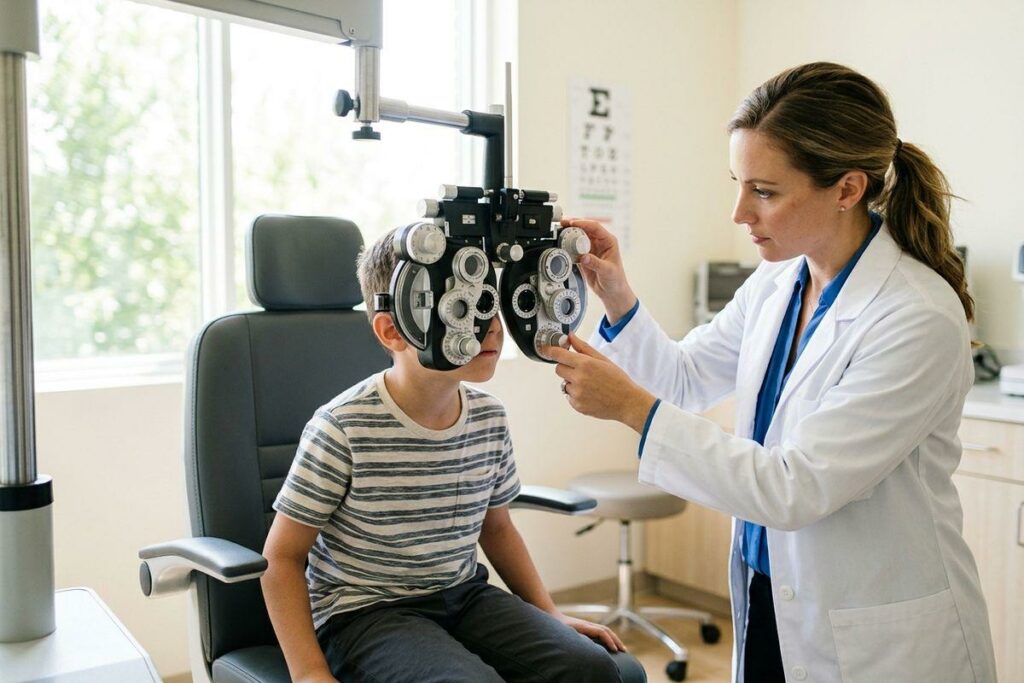
An eye exam can confirm which refractive error you have and how strong it is. From there, our team matches your correction to how you actually spend your days, whether that’s highway driving, hours at a keyboard, or reading with a grandchild on your lap.
Book Your Next Eye Exam
Whether it’s the road signs, the small print, or a kid who keeps inching toward the screen, you don’t have to sort out the difference on your own. Our team at Eye Care for East Texas can check your vision, explain what they find in plain language, and help you choose a correction option that fits your life. Call to schedule an exam for yourself or your whole family today.